Skin and Coat: Infections Overview
Skin and Coat Quicklinks
Causes:
There are number of microbial agents which inhabit a dog's
skin and hair. Once the colonies of such bacteria exceed the
normal amount, the bacteria may cause a severe skin infection. Various
species of
bacteria such as Staphylococcus, Streptococci, Micrococcus,
Actinobacter,
Bacillus, Pseudomonas and many more are such examples. Some of them are
obligatory (common) and some are transient (temporary) residents of dog
skin.
Signs and Symptoms:
Skin infections in dogs can be categorized as being superficial or deep in the skin. The deeper the infection, the more complications and in turn, they take a longer time to recover.
Superficial signs appear as scaling of the skin, topical alopecia (hair loss), inflammation, redness, papular eruptions (small solid eruption of the skin that does not contain puss), crusts, and severe pyoderma (puss). In dogs with short hairs, the hair will look hard and the hair follicles will appear to be ruptured. Severe itching and scaling causes dogs to scratch their skin which results in abscess formation (area of puss), which is more complicated and involves deep tissues as well.
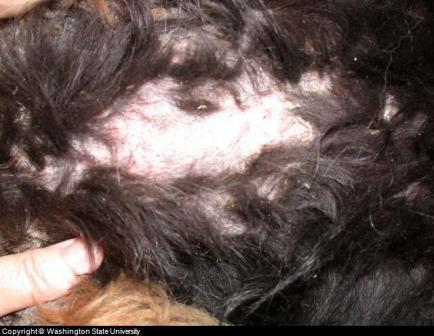
Dog skin infections that
are superficial on skin of a longhair black Dachshund
Source: Washington State University
Deep pyoderma (puss filled ulcer), another form of dog skin infection causes severe pain, pruritus (severe itch), bad odor and hemorrhagic lumps (bloody) on the skin. Pus containing blood exudates (fluid) flows out of the infection site more frequently & dog tries to lick these secretions.
Deep skin infections are more frequent at the muzzle, elbows, neck, inter digital areas, hocks (ankle joint) and around the inguinal (groin)region.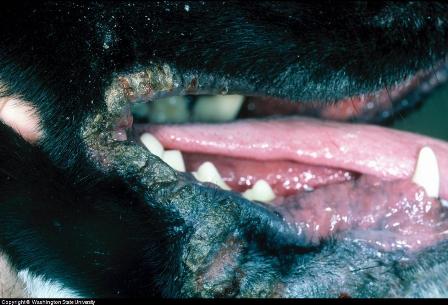
Dog Skin infections are common on the lips as pictured here
Source: Washington State University
Generalized skin infections may also cause fever, tiredness, ataxia (lack of muscle coordination) and loss of appetite.
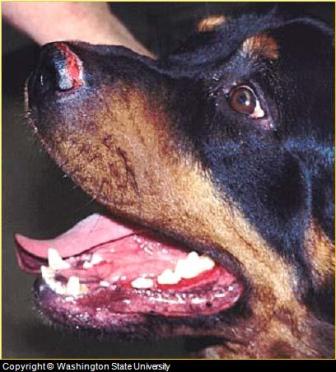
Nose Infection that is Superficial
Source: Washington State University
Diagnosis:
Usually clinical signs, history and a physical examination
will reveal a superficial skin infection, but a deep skin problem can
only
be diagnosed by careful laboratory examination and approaches which
help a veterinarian choose between different possible causes.
Dog skin infections should be differentiated from mange,
dermatophytosis, flea infestation, hair loss due to hypothyroidism and cancerous
growths. Parasitic infestations can be diagnosed by
examining deep skin scrapings.
Confirmatory diagnostic tests are carried for not only determining
the exact
specie of bacteria causing the skin infection, but also helps in
selecting
the appropriate antibiotic for treatment.
The application of different approaches to radiation such as X – Rays, Electrons & Gamma Rays are all common options to restrict cancerous cellular growth. In most cases radiation therapy has prove to be effective, but possess severe adverse side effects.
Treatment:
Primarily, the use of an antibiotic therapy is preferred.
General
antibiotic therapy and topical application of antibiotics are two
options to select from. Supportive supplementation by multi vitamins
& minerals enhances the recovery rate. More then 21 days are
usually required for complete antibiotic and recommended supportive
care for complete recovery, while deep skin infections and
severe pyoderma may take 7 – 8 weeks before it’s completely over.
Lincomycin, clindamycin, sulfadiazine, cephalosporin &
chloramphenicol are the most commonly used antibiotics.
Topical application of antibiotics is only effective in superficial dog
skin infections. An ointment containing 2% mupricin is considered very
effective in dogs. It is usually recommended that ointment is applied
to
skin for at least twice a day until complete recovery.
Supplementary options like those of multi
vitamins, especially
vitamin
C and minerals can improve conditions, physiology and reduces
recovery period. The use of a natural
homeopathic remedy may also help.
Extensive care should be taken to isolate affected
dogs so that
the chances of transmission to other dogs via contact can be reduced.
Professionally grooming dogs with skin infections is highly preferable.
Dogs should not be allowed to
lick affected areas and of course should be kept away from dirt.
Affected dogs with superficial skin infections should be bathed 2 – 4
times a week during the first two weeks of treatment and then 1 – 2
times
a week, until infections are resolved. Medicated shampoos should be
diluted to 1:2 & 1:4 in water and should be lathered before
applying. Shampoos containing benzoyl peroxide, chlorohexadine
& triclosan are preferred.
Shampooing will reduce the bacterial population, scales &
crusts.
thus improving chances of early recovery.
|
|
