Finding a tick on your dog, or a bump where one was attached, is common, especially from spring through fall. This page shows what the main U.S. ticks look like before and after feeding, what a tick bite usually looks like on a dog and on a person, and the signs that mean it's time to call your vet. Dogs are very susceptible to tick bites and the diseases ticks carry, so it's worth knowing what to look for.1
Call your vet if, in the weeks after a tick bite, your dog:
- Has a fever, low energy or a poor appetite
- Is lame, or has swollen or painful joints
- Has swollen lymph nodes2,3
- Has a bite site that becomes more red, swollen, painful or starts to drain4
Get emergency care if your dog suddenly develops weakness in its back legs, a change in its bark, or trouble breathing. These can be signs of tick paralysis.5 Signs of tickborne disease may not appear for 7 to 21 days or longer after a bite, and Lyme disease often takes 2 to 5 months.1,2
What Does a Tick Bite Look Like on a Dog?
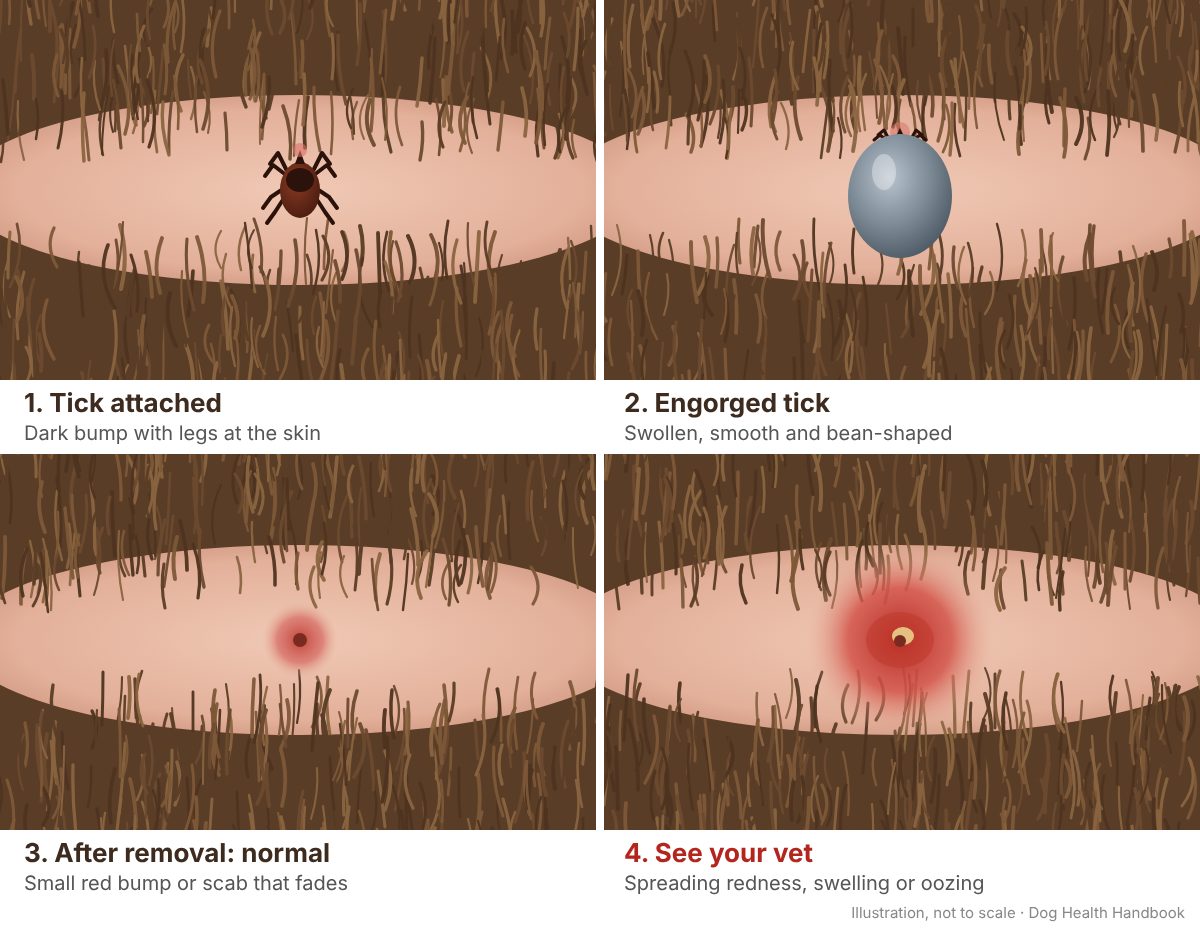
A tick bite on a dog usually looks like a small red bump, a slightly raised patch of skin or a tiny scab where the tick was attached.4 If the tick is still attached, you may see or feel a dark bump. A tick that has been feeding for a while can look like a seed, a wart or a small skin growth.4
- A small red bump after removal is normal. It may stay slightly red or raised for a short time and should gradually fade.4
- Mouthparts left in the skin can cause a small, firm lump (a granuloma), which is why ticks should be pulled straight out without twisting or crushing.6 Leftover mouthparts are usually pushed out as the skin heals, so don't dig at the skin.7
- Watch for signs of infection: a bump that keeps getting bigger, feels hot, oozes, is painful or that your dog keeps scratching or licking needs a vet check.4
- Don't rely on a rash to spot Lyme disease. The bull's-eye rash is a sign of Lyme disease in people.8 In dogs, Lyme disease shows up as fever, lameness, swollen joints and low energy, often months after the bite.2,3
Real tick bite pictures on dogs:
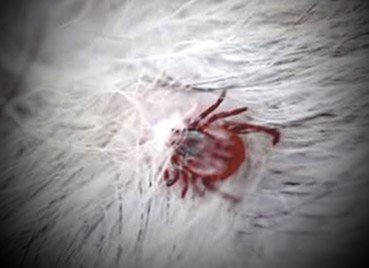
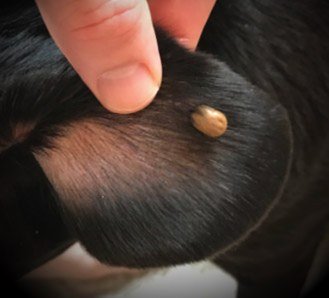
Tick or skin tag? Look closely with a light and a magnifying glass. A tick has legs near the skin (8 legs on adults and nymphs), while a skin tag or mole is attached to the skin and has none. If you're not sure, ask your vet before you pull at it.
Where to Check Your Dog for Ticks
Check your dog every day during tick season, especially after walks in woods, long grass or brush. Run your fingers slowly through the coat and look closely at:1
- In and around the ears and around the eyelids
- Under the collar
- Under the front legs and between the back legs
- Between the toes
- Around the tail
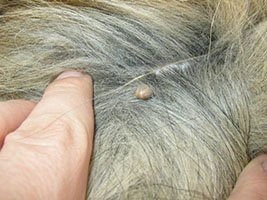
Ticks are hard to spot on dogs with long or dark fur, so use your fingers as well as your eyes.1
Pictures of Common Ticks Found on Dogs
Different ticks carry different diseases, so it helps to know which one you've found. These are the main ticks that bite dogs and people in the United States:9

Blacklegged tick (deer tick): found widely across the eastern United States, with the western blacklegged tick along the Pacific coast. It carries the bacteria that cause Lyme disease and anaplasmosis, as well as babesiosis and Powassan virus.9 See our guide to Lyme disease in dogs.

Lone star tick: widespread in the South, Midwest and Northeast. The adult female has a distinctive white dot on her back. It carries ehrlichiosis and tularemia, among other infections.9 See our page on ehrlichiosis in dogs.

American dog tick: widespread east of the Rocky Mountains, with a related species in the West. It can spread Rocky Mountain spotted fever and tularemia.9
Brown dog tick: found worldwide. Unlike most ticks, it can live indoors and in kennels, hiding in cracks and crevices, and can infest a home in any season.9,6,1 It can spread Rocky Mountain spotted fever, mainly in the southwestern U.S. and along the U.S.–Mexico border.9
What Does an Engorged Tick Look Like?

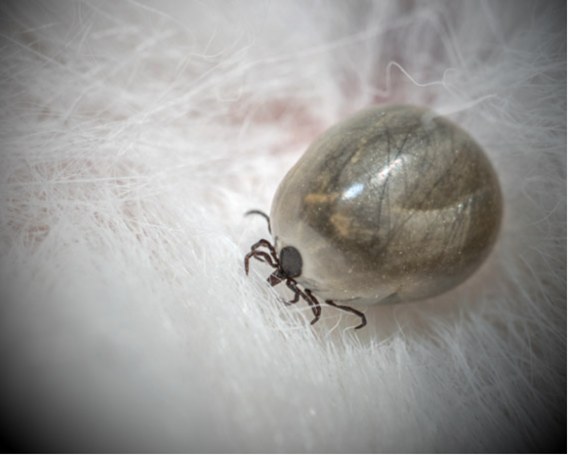
As a female tick feeds, its body swells with blood. Female hard ticks can grow to as much as 100 times their original weight before dropping off, so an engorged tick can look like a smooth, round bean or skin growth. Males change little in size.6
A large, engorged tick has probably been attached for a while. That matters because the risk of infection rises the longer a tick feeds: the Lyme disease bacteria usually need 24 to 48 hours of attachment, but some other infections, such as ehrlichiosis and Rocky Mountain spotted fever, can be passed on within 3 to 6 hours of attachment.6,2 Remove any tick as soon as you find it.1
Tick Bite Pictures on People

Dogs can carry ticks into the home, so it's worth knowing what a bite looks like on people too.1 Most tick bites leave a small red bump. The rash to watch for is erythema migrans, the rash of Lyme disease. It appears in about 70 to 80% of infected people, starts 3 to 30 days after the bite, and grows over several days, sometimes to 12 inches or more. It may clear in the middle to form a bull's-eye, but not always, and it usually isn't itchy or painful.8

See a doctor if you develop a rash or fever in the weeks after removing a tick, and tell them about the bite.7
What to Do if You Find a Tick on Your Dog
- Remove it right away with fine-tipped tweezers, gripping it as close to the skin as possible. Wear gloves if you can.7,6
- Pull straight out with slow, steady pressure. Don't twist, jerk or crush the tick.7,6
- Don't use petroleum jelly, heat, nail polish or other "smothering" tricks.7
- Clean the bite and your hands afterward.7
- Save the tick in a sealed container of rubbing alcohol in case your vet wants to identify it.6
- Watch your dog for changes in behavior or appetite over the next few weeks.1
For step-by-step help, see our guide to removing ticks from dogs. To stop ticks from biting in the first place, see our guide to tick prevention for dogs. Veterinary parasite experts recommend tick control all year round.6
Diseases Dogs Can Get From Tick Bites

- Lyme disease: fever, lameness, swollen joints, swollen lymph nodes and low energy, often 2 to 5 months after a bite. Most exposed dogs never get sick.2 See Lyme disease in dogs.
- Ehrlichiosis and anaplasmosis: the main cause of ehrlichiosis in dogs is spread mainly by brown dog ticks, and other forms are spread by lone star ticks. Anaplasmosis is spread mainly by blacklegged ticks.10,9 See ehrlichiosis in dogs.
- Rocky Mountain spotted fever: spread by American dog ticks, Rocky Mountain wood ticks and brown dog ticks.9
- Tick paralysis: early signs include a change in voice, wobbly back legs and changes in breathing, typically 3 to 9 days after the tick attaches, depending on the type of tick. Most dogs in North America improve greatly within 24 hours of the tick being removed, though some get worse for the first day before recovering.5
See our overview of tick diseases in dogs.
Frequently Asked Questions
What does a tick bite look like on a dog?
Usually a small red bump, a slightly raised spot or a tiny scab. If the tick is still attached, you'll see a dark bump with tiny legs at the skin. The spot should fade over the following days.
Is it normal for a lump to form after a tick bite on a dog?
A small bump for a short time is normal. A firm lump can form if the tick's mouthparts were left in the skin. See your vet if the lump keeps growing, oozes, is painful or doesn't go away.
How soon after a tick bite will a dog get sick?
Signs of tickborne disease may not appear for 7 to 21 days or longer, and signs of Lyme disease often take 2 to 5 months. Tick paralysis is the exception: it can start within days while the tick is still attached.
I found a tick on my dog. Should I be worried?
Remove it promptly and watch your dog for the next few weeks. Most tick bites don't make dogs sick, and prompt removal lowers the risk. Call your vet if your dog develops a fever, lameness, low energy or a poor appetite.
Do all ticks carry Lyme disease?
No. In the United States, Lyme disease is spread mainly by blacklegged (deer) ticks, and by western blacklegged ticks on the Pacific coast. Other ticks, such as lone star and American dog ticks, spread different diseases.
Do dogs get a bull's-eye rash from a tick bite?
The bull's-eye rash is a sign of Lyme disease in people. In dogs, Lyme disease shows up as fever, lameness, swollen joints and low energy, often months after the bite, so don't wait for a rash.
Does Dawn dish soap remove ticks from dogs?
No. Soaps and "smothering" methods don't reliably detach ticks. Use fine-tipped tweezers and pull the tick straight out.
What are the tiny ticks on my dog?
Very small ticks are usually young ticks (larvae or nymphs). Nymphs in particular can spread disease, including Lyme disease. Remove them the same way as adult ticks, and if you find many, especially indoors, ask your vet about brown dog ticks.
Ask Our Team a Question
Help Others by Asking aTick Bite Related Question!
Have a question or story to tell related to ticks and tick bites? Our editorial team will answer questions for free!
Please include information such as your dog's medical history, age, sex, breed, symptoms, diet, changes in behavior and medications. Providing pictures by uploading them below can also be of help.
We will do our best to get back to you quickly (it depends on how many questions we receive each day). If you do require an immediate response we suggest using this online dog veterinary service that is available now. Note they charge a small fee for this service.
What Other Visitors Have Asked and Suggestions from Our Team
Click below to see contributions from other visitors to this page...
My 3-Month-Old Puppy Was Bitten by a Large, Engorged Tick Not rated yet
Reader Question My 3 month old dog has been bitten by a large light green tick, we have the removed it and the head and have cleaned the wound with …
White Bump Caused By Dog Tick Not rated yet
Reader Question: Is This A Serious Case Of Ticks?
I removed a tick from my dog that had probably been on her for 3 to 4 days. I feel like it was a …
Tick With a Red Ring on My Puggle: Does Trifexis Protect Against Ticks? Not rated yet
Reader Question My 3 year old Puggle is currently on Trifexis. I found a very dark brown tick on his neck, got it off but there was a red ring around …
Itchy Spot With a Black Dot on My Ankle: Could It Be a Tick Bite? Not rated yet
Reader Question Yesterday there was a severe itch on my right leg near the ankle. I scratched it and today I see a black dot in the area and some redness. …
Red Ring Around a Bite on My Dog: Could It Be Lyme Disease? Not rated yet
Reader Question I picked my dog up from the kennel and as soon as we got home my son noticed what looked like a drop of blood on its chest. After closer …
Sources and further reading
This article was rewritten and fact-checked on October 13, 2026 against current veterinary references and specialist guidelines:
- U.S. Centers for Disease Control and Prevention. Preventing ticks on pets, May 2024.
- Cornell University College of Veterinary Medicine, Riney Canine Health Center. Lyme disease.
- Roman N. Lyme disease (Lyme borreliosis) in dogs. Merck Veterinary Manual (Pet Owner Version), reviewed June 2026.
- The Drake Center for Veterinary Care. What does a tick bite look like on a dog?, August 2026.
- Atwell R. Tick paralysis in dogs. Merck Veterinary Manual (pet owner version), updated September 2024.
- Companion Animal Parasite Council. Ticks guidelines, updated March 2023.
- U.S. Centers for Disease Control and Prevention. What to do after a tick bite, June 2026.
- U.S. Centers for Disease Control and Prevention. Signs and symptoms of Lyme disease, May 2024.
- U.S. Centers for Disease Control and Prevention. Where ticks live, July 2025.
- Palerme J-S. Ehrlichiosis in dogs. Merck Veterinary Manual, reviewed September 2025.
About this article
Last updated : fully rewritten using current CDC, Companion Animal Parasite Council, Cornell and Merck Veterinary Manual guidance; corrected tick identification details (including that brown dog ticks can spread disease), added what a tick bite looks like on a dog, where to check, removal steps, warning signs, a key takeaways summary and FAQ. Photos: CDC.
This page is for general information and is not a substitute for an exam by your veterinarian.
