Skin and Coat: Staph Infection
Skin and Coat Quicklinks
Cause of Staph Infections in Canines:
Staph bacteria exist on most dogs, but usually remain in a harmless state until triggered by another medical issue. Staph can be triggered by any condition that causes an allergic reaction or inflammation of the dog’s skin.
Contact with pollen, fertilizer, grass or an allergic
reaction to food can cause inflammation which leads the dog to scratch.
This in turn creates cuts and sores, which allow the bacteria to burrow
down into the pores and become an active infection.
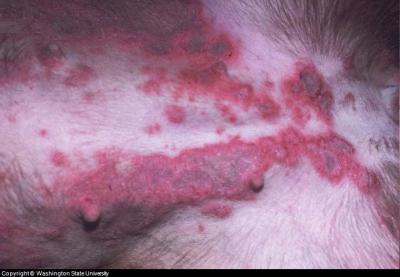
Staph infections can be similar in appearance to this superficial infection on the abdomen of a Labrador retriever
Signs and Symptoms:
A few of the signs and symptoms of staph infection include:
- Rapid and sudden hair loss
- Hard and crusty sores on the abdominal area
- A rash on the dog’s head or feet
- Blood or pus-filled blisters
Also, a dog that constantly licks or chews his paws could be showing signs of an allergy. The constant licking and chewing can cause the skin on a dog’s paws to become inflamed – which can lead to a staph infection.
Diagnosis:
Staph infections in dogs are the manifestation of an underlying problem, therefore the actual cause of the infection needs to be discovered and treated. Diagnosis of the underlying problem can consist of several tests and procedures, such as a skin scraping to test for mites, skin cytology to test for bacteria and yeast, and a fungal culture to check for ringworm or other parasites.
A veterinarian will also need to know a history of the food the dog has eaten and if the dog came into contact with any triggers, such as pollen or fertilizer. Treatment of Staph Infection in Dogs:
Staph Treatment:
Treating a staph infection in dogs consists of a 6-week round of antibiotics such as Simplicef. If after the first round of antibiotics the condition is still present, additional weeks of antibiotics can be given, until all signs of the skin infection have been absent for a week.
A topical ointment can be applied to open sores and wounds, and the infected areas should remain bandaged, with the bandages changed frequently.
Removing the hair from around the affected area and frequent bathing of your dog will speed up the healing process. Antibacterial shampoos (benzoyl peroxide (2-3%), clorhexidene (2-4%), ethyl lactate (10%) , Chitosanide and spherulite-based shampoos such as Virbac Sebolux. Apply dog shampoos 1x to 2x per week. The shampoos can also be continued after the dog staph infection heals as a maintenance strategy.
If a dog has a deep bacterial skin infection, soaking a dog
with an iodine
dog shampoo could be of value. If the
skin infections are localized to a specific area of the body, a topical
containing benzoyl peroxide such as Virbac
Pyoben Gel is of value. If a dog has
in-grown
hairs causing inflammation, massage these out of the skin in a warm
water bath.
Your Vet might prescribe medication to boost your dog’s immune
system (staphylococcal product such as Staph Phage) . Also, all areas
where the dog frequents need to be cleaned and
disinfected with a quality disinfectant such as Benzarid.
Otherwise, some of the bacteria could remain in the home
and the dog could again become infected.
Last, along with specific therapies recommended by a
veterinarian, homeopathics can be used to support the healing
process. For example, skin and coat health can be helped with
products such as Skin
and Coat Tonic . The immune system may
also benefit from added support from a remedy such as Immunity
and Liver.
Reoccurring Infection Treatment
If the dog staph infection continues to return after treatment
is completed, have the veterinarian evaluate your dog for causes such
as seborrhea or some type of dog parasite problem such as mange mites.
If these are not the cause, have your dogs thyroid function
evaluation, and skin tests for allergy.
It can't hurt to try a dog allergy diet, where all foods are eliminated
except very simple proteins and carbohydrates (e.g; provide chicken and
rice and eliminate all other ingredients that could cause food allergy
in dogs).
Continue to use shampoos as recommended above. If they are not effective, alternate with a shampoo that is anti-seborrheoic such as Duoxo.
|
|
