Eye: Canine Eye Drops
Formulation of Dog Eye Drops:
There are three different routes of administration of drugs/therapeutics for dog eye problems:
- topical (over and around eye)
- local ocular (for the conjunctiva, intraviteral, intracameral and retrobular)
- systemic administration via oral medications
Route selection depends upon the nature of the canine eye problem and requirements. Out of the first two routes i.e. topical and local ocular routes, eye drops dog are the most common form of preparation used.
It is estimated that about 80% of dog eye problems are treated with the help of canine eye drops. These drops contain many types of drugs. These products contain an aqueous or liquid component, which is most commonly a buffer solution combined with one or more therapeutics such as antihistamines (for allergies), antibiotics (for infections, known as canine antibiotic eye drops), corticosteroids (injuries), mild irritants (to enhance tear production), dilators (for widening eye aperture) etc.
Eye Drops for Different Canine Eye Conditions:
Dog Eye Cleaning; A requirement of dog eye care is regular examination and cleaning by owners. This can be easily be done with help of the many eye drops dog options. Commercially such eye drops are available and are usually called “dog eye cleaners”, which contain an isotonic solution (simulates natural eye liquid), which clears the surface of the eye and makes the eyes appear brighter. Some quality dog eye cleaning solutions may contain additional components as well, which improves overall visual health and cellular integrity. Such cleaning drops should be used only with instructions from a veterinarian. Look for a product such as PNP Dog Eye Wash.
Dog Eye Infections: Dog eye problems caused by microbes, whether primary or secondary in nature, are treated locally with the help of dog eye drops containing antibiotics and some supportive ingredients. Such eye drops should only be administered with a prescription and owner's should never try to administer them on their own, since many dogs may be sensitive towards antibiotics and also the dosage is always required to be decided prior to administration by a veterinarian.
Dog Eye Allergies and Conjunctivitis: Dog eye conjunctivitis is inflammation of the mucous layer of the inner eyelids, most commonly noted in cases of dog eye allergies. These allergies are an immune disorder, which are usually managed with the help of anti histamines or anti allergy drugs. Eye drop for dog use contain anti histaminic drugs. This combined with repeated eye cleaning can help to control dog eye allergies. In some cases, where allergies are accompanied by a dog eye infection; antibiotics and anti histamines can be administered in combination, in the form of canine eye drops. A veterinarian should always be consulted before administration.
Drops with Natural Remedies:
Various natural and herbal extracts can help to improve the overall visual health of dogs. Additionally, these can be used to support specific eye therapy , i.e. they enhance recovery and the healing process. Commercially, these natural remedies are available in the form of dog eye drops, which can be easily administered as per the instructions of the manufacturer, and do not require any prescription. Though these remedies are safe to use according to the instructions, it is always better to consult a veterinarian before administering these remedies, since eyes are delicate organs and owners should never compromise or try to handle any dog eye problem themselves.
Two products to review include Eye Heal and i-Clenz. Eye Heal can be used directly over the surface of the eye, to improve eye health, healing and support any therapies recommended by your veterinarian. i-Clenz is a cleansing remedy which can be used to clean the area around the eyes (eyelids, lashes and face) to prevent any bacterial growth. Though the manufacturer suggests it as an eye cleaner too, it should be used only with care if used directly in the eyes.
How to Apply Eye Drops in Canines:
It is easier to apply dog eye drops with the dog is lying down on a table as depicted below:
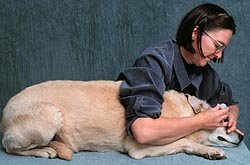
Applying Drops in Right Eye
Source: Washington State University School of Veterinary Medicine
After placing the dog on the table, stand behind the head and
eye that requires the drops. Place your right arm on the
dog's shoulders to hold the dog in place. The right hand should hold
the eye dropper. With your left hand, hold the muzzle on the
table and pull back the eyelid down. Administer the drops
with the right hand.
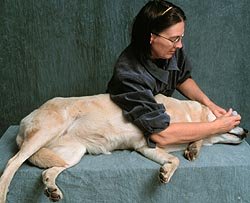
Administering Eye Drops
If your dog is difficult to hold, you can lean over the dog using your upper body.
|
|
