Cancer: Diets and Nutrition
There is a growing body of research regarding the best foods and nutrition for a canine cancer diet. Studies support the idea that diet can help prolong your dog's life and improve the quality of life. Goals for a nutritional program are to reduce the growth of neoplasms (cells that grow uncontrollably) and to help dogs that are losing weight during treatment. The way these cells are slowed down is by understanding which parts of food "fuel" these cells and then reducing them in the diet.
There are many of components of a dog cancer diet such as fats, proteins and carbohydrates and nutrients such as vitamins, minerals, fatty acids and amino acids. All are thought to play a role cancer dog nutrition decisions.
Overall, It is a good idea for a a diet for dogs with cancer to follow the nutrition guidelines of the National Research Council of the National Academies.
Daily
Recommended Levels of Fats and Proteins for Dogs
(Source: National Academy of Sciences)
|
Puppies |
Adults (Weighing 33 lb) |
Nursing/Pregnant
(Weighing 33 lb with 6 puppies) |
|
| Protein | 56g | 25g | |
| Fats | 21g | 14g | 29g/67g |
Note that pet food labels list percentages. Multiply the "crude fat" percentage on the label multiplied by the weight of the serving to get the # of grams. As a general guideline 5.5% minimum of diet from fats and 10% from protein, and 50% from carbohydrates.
Cancer Diets for Dogs
When a dog's body has cancer, the neoplasms (cancer cells) are fueled by simple sugars or glucose (glycosis). Since glucose comes from carbohydrates, and most dog foods are 50% carbohydrate, it is important to understand what types of carbs are in the food and which ones are good and bad. Foods are therefore preferred which have high levels of protein and fats and low levels of simple carbs and moderate amounts of complex carbs.
Simple carbs (sugars) to avoid:
- Sugar
- Sucrose
- Glucose
- Dextrose
- Rice Syrup
- Honey
- Corn Syrup
- Maple Sugar
- Milk
- Fruits
- Carrots
- Beets
- Squash
- Turnip
- Sweet Potatoes
Complex Sugars shouldn't be avoided, but moderated, since they do have a role in fueling the energy for muscles:
- Breads
- Cereals
- Grains
- Rice
- Potatoes
- Vegetables
- Fruits
- Pasta
Fat, Protein and Carbohydrate Guidelines
Most premium dry and canned goods will meet the requirements for high protein and fat if they have high fat and protein levels vs. maintenance diets which have more carbs.
Unfortunately, the water content in canned foods makes it difficult to compare dry and canned, Here is a chart that describes how to compare the two and that provides recommended levels of each component.
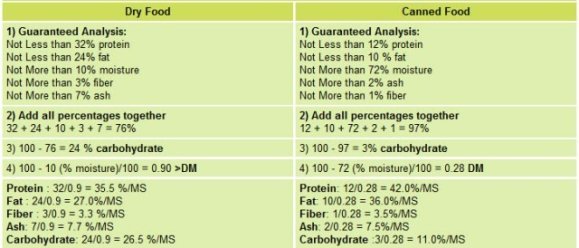
Source: Nutritional Status of Dogs with Cancer: Diabetic Evaluation and Recommendations J.J. Wakshlag and F.A. Kallfelz, College of Veterinary Medicine, Cornell University
Commercial Brands
There are commercial dog foods that are made specifically to support the needs of a dog cancer diet, particularly when undergoing radiation or chemotherapy. These include products such as Hill's Prescription Diet n/d is specifically made for dogs with cancer. It is balanced to reflect the latest research on this subject. The goal is to starve the cancer cells, while maintaining the dog's physiology (condition).
Canine cancer diet dog foods are protein rich to help maintain muscle and provide the body with energy. They are also formulated to encourage a dog to each via higher levels of fat and have low levels of carbohydrates. They also contain arginine and Omega-3 fatty acids to provide immune system support.
When selecting a dog food make sure that it has two labels which indicate that is is manufactured to the highest levels of quality:
- "complete and balanced"
- "nutritional adequacy was validated by animal feeding tests based on protocols from the American Association of Feed Control Officials" (AAFCO)
Also make sure it carries the AAFCO seal (American Association of Feed Control Officials), the dog food industry regulatory group. Note that there is another label that is a step below the one listed above "food was formulated to meet the AAFCO nutrient profiles". Avoid this second label in favor of the two listed above.
Homemade Diet for a Dog With Cancer
There are over 40 components to a dog's diet that need to be taken into consideration when providing a homemade diet. It is for this reason that most veterinarians recommend a commercial diet over a homemade canine diet. That said, the site canine cancer awareness provides some credible recommendations for those that want to go at it alone. Even is providing a home made diet, it should be supplemented with a commercial diet. The site recommends this recipe which will feed a dog that is 25 to 30 pounds for 3 days:
Ingredients
|
- Feed the level of fish oil that is tolerated by your dog. It isn't practical to achieve levels at home that are similar to those in Hill's N/D.
- Oyster sheel calcium tablets or Tums tablets (0.5 g in regular Tums, 0.75 g in Tums Extra and 1.0 g in Tums Ultra) can be used when provided calcium carbonate.
- In place of dicalcium carbonate you can use Bone meal
Directions:
Cook the rice and add salt substitute to the water.
Drain the fat while cooking the ground beef
Cook the liver and finely chop or dice into small pieces.
Pulverize the vitamin/mineral tablets and calcium carbonate.
Mix the fish oil (break open capsules), vegetable oil, and supplements with the rice and then add the cooked ground beef and liver.
Mix well, cover and refrigerate.
Feed approximately one-third of this mixture each day to a 25-30 pound dog.
To inmprove palatability heat the daily portion to body temperature (Caution: if you microwave food, check for “hot spots,” to avoid mouth burns).
Nutrient Profile (% dry matter basis):
- Protein 35.3
- Fat 41.6
- Carbohydrate 17.8
- Calcium 0.65
- Phosphorus 0.54
- Sodium 0.36
- Potassium 0.68
- Magnesium 0.05
- Energy 1,989 kcal/kg as fed
Supplements
Antioxidants - While many scientists and researchers believe that anti-oxidants for dogs can be helpful in preventing cancer, there is some debate as to whether or not anti-oxidants or providing additional anti-oxidants are helpful for dogs with cancer that are undergoing treatment. The reason is that some veterinary oncologist believe that cancer cells may actually benefit from the increase in anti-oxidants in the cell since they act to protect cells. Check with your oncologist for the latest thinking on this issue.
Omega 3 Fish Oil - Fish oil is thought to have a positive effect on dogs with cancer and could potentially be of benefit. In human studies fish oil helps with the recovery from radiation therapy and helps to reduce inflammation in the areas surrounding those treated. It might even help accelerate the death of cancerous cells during treatment. There is a strong positive correlation between omega 3 supplementation and survival times.
Arginine - This amino acid has been shown to flow the growth of tumors in animals. It is thought that 2% of the amino acids (component of protein) provided to dogs with cancer should be arginine.
Homeopathic Remedies
- There is a growing body of evidence that combinations of homeopathic
remedies such as
C-Caps Formula for Prevention and Treatment of Cancer in
Pets. C-Caps could be a helpful supportive therapy for a canine cancer
diet. This approach is thought to boost the immune system, thereby
helping your dog fight cancer. Follow the C-Caps link for access to
additional information and supporting research on this approach.
|
|
