Urinary: Senior Incontinence
Urinary Quicklinks
There are several causes of incontinence in older dogs. Common causes include:
Cause of Incontinence in Older Dogs:
- Cognitive Dysfunction (known as doggie Alzheimer's)
Causes of Incontinence in all Dogs
- Bacterial Infection - infection can trigger an urge to urinate. An infection that has been in place for a long time can cause scarring which can prevent the bladder from stretching to hold urine.
- Blockages - canine bladder stones or a neoplasia/tumor can
cause a blockage in the urethra, the tube that carries urine from the
dogs body. Blockages can also cause an enlarged bladder due to blocked
urine flow, resulting in leaks.
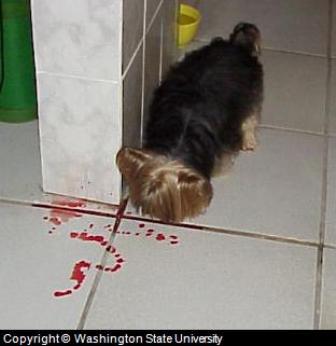
Old Dogs Incontinence
Pictured: Dog with Bleeding Due to Bladder Stone
Source: Washington State University - Diabetes Mellitus
- Cushing's Disease
- Kidney Disease
- Separation Anxiety
- New Dog in Household
- Seizures
- Nerve Problem with Hind Legs
Causes of Incontinence in Spayed Female Dogs
- USMI - weakened sphincter muscles
- Vulvovaginal Stenosis - problem with the urethra where the end of the urethra narrows. The narrowed passage causes some urine to be left behind in the urethra after urination. The urine then leads out when the dog stands up after lying down.
Canine Cognitive Dysfunction (CCD)
If you find that your dog's behavior has become disoriented. This can include fecal incontinence (defecating in the house) and urinating in the house, then your dog could be suffering from cognitive dysfunction.
Symptoms of CCD:
- No recognizing familiar family members or locations
- Wandering
- Restless at night
- Urinating in the house (as mentioned above)
Treatment of Canine Cognitive Dysfunction
Diagnosis of canine incontinence starts with a urine test to determine if their is any bacterial infection which is causing the problem.
There is a prescription medication called Anipryl. It is not effective in all cases. Possible side effects include tremors and restless behavior. Natural approaches to treatment include melatonin (not to be used if your dog has diabetes mellitus). Dietary change may also help. It is thought that diets that are high in fatty acids and that contain antioxidants might help. One product that is made with this problem in mind is Hill's Prescription Diet b/d.
You can also try a homeopathic remedy made to help dogs with memory loss such as Performance Plus Formula which helps to to naturally boost concentration, memory and mental alertness in dogs. It contains ingredients such as Hydrocotyle asiatica (well known memory aid), Rosmarinus officinalis (helps to control free radicals in the body and improve circulation) and Arthrospira platenis (anti-oxidant and anti-inflammatory properties).
General Reasons for Old Dogs Incontinence
Neurogenic Incontinence
When a dog is unable to close off the flow of urine in the urethra, incontinence problems can occur. This issue can be caused by a problem with the lower part of the back or spine, back joint disease, spinal cord degeneration. All of these issues interfere with the nerves that control the bladder.
What happens is the muscles that control the bladder become weaker. The bladder eventually fills to capacity, forcing some urine past the urethral muscles that are trying to keep the bladder closed. This is why the urine comes out in spirts or dribbles.
Diagnosis of this problem is done with a procedure called a cystometrogram where a catheter is inserted into your dogs bladder, and your veterinarian measure the bladder reaction to different amounts of fluid.
Treatment can be difficult. If the spinal cord injury or disease can be corrected, then the incontinence may correct itself. Medications may also help that strengthen the bladder. You could also research the "Bladder Control" homeopathic remedy mentioned below to see if it could be of help.
Urethral Sphincter Mechanism Incontinence (also called Hormone Responsive Incontinence)
If any of the aforementioned problems are not the cause, then USMI could be the cause (Urethral sphincter mechanism incompetence). This condition occurs in female cats up to 10 years after you cat has been spayed. This is often the problem when your dog urinates while sleeping. The exact reason spaying causes the condition is not completely understood.
Diagnosis is made by using a test called a urethral pressure profile. Prescription medications are helpful in improving muscle control. (phenylpropanolamine, pseudoephedrine). Potential side effects include high blood pressure, anxiety and restlessness. Your veterinarian may also recommend estrogen therapy or injections of collagen (Contingen).
You can also try a homeopathic remedy that can provide some temporary relief for old dogs incontinence. The product, PetAlive Better-Bladder Control is formatted to naturally relieve incontinence and strengthen the bladder.
Old Dogs Incontinence - Overflow Bladder
If there is a blockage, infection or tumor (neoplasia) then there may be a blockage keeping the urine from flowing properly.
Infection causes the urinary tract to become inflamed. Inflammation narrows the passages, restricting the flow of urine and crystals, the building blocks of urinary or bladder stones. As the crystals attach to one another they grow in size and eventually block the flow of urine.
These conditions are diagnosed by testing the urine and through an examination of the urinary tract using x-rays, ultrasound or an endoscope (probe inserted through the urethra).
Bacterial Infection: Treatment varies depending on the cause. Bacterial infection can be taken care of with common antibiotics. You can help prevent future infection and accelerate the process with a homeopathic remedy for UTI (canine urinary tract infection) such as UTI-Free Formula.
Bladder Stones (uroliths, cystitis): Small stones can be flushed from your dog's system or dissolved with medications. If the stones are struvite stones, a type of bladder stone, then a change in diet to Hill's Prescription Diet s/d might help. If the stones are oxalate, the most common type, they may need surgical removal. Prevention of future stone formation would require a change in diet and encouraging your dog to urinate more often (via an additional walk, more water consumption).
Kidney Failure: In dog's that are suffering from kidney failure, a symptoms is the need to urinate more often. If you dog doesn't have the opportunity to be outside more, the full bladder could cause cases of old dogs incontinence in the house.
|
|
