Ear Care: Scratching
Dog Ear QuickLinks
Cause of Ear Scratching:
Canine ear scratching is a symptom itself and can indicate different infectious and non infectious ear problems. Dogs may scratch their ears when their ears feel itchy. Repeated scratching can leave a dog with more severe itch problems and ear injuries.
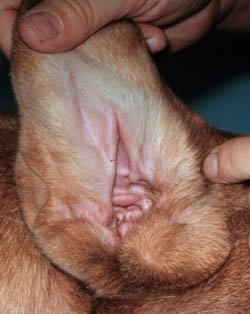
Picture of Healthy Dog Ear
Itching and discomfort in a dog’s ear can be caused by number of factors. Mites and flea infestation are the most common causes of a dog scratching ears, resulting in severe skin lesions, bumps and alopecia (hair loss) along with secondary bacterial infections. Similarly, fungal and bacterial infections in the ear can cause lesions and damage to different histological layers of the ear, resulting in itching and finally the dog continually scratching the ears.
Some non infectious causes such as excessive ear discharge, dog ear wax buildup and tumors located in the ear can cause itchiness. Similarly environmental debris, excessive hair around and in the ear can also cause discomfort to a dog.
Clinical Representation:
Some dogs may scratch their ears habitually, but the incidence of this problem in the population is low. Most dogs scratch ears due to sub clinical (developing) or clinical (mature) ear problems.Dogs may only scratch the ears if it feels an itch and discomfort in the area around and in the ears, itching is thus the basis for the scratching problem, which has multiple causes.
Along with scratching and itching, other symptoms are experienced including discomfort, lesions, alopecia (hair loss), inflammatory pain and discharges etc. some conditions may develop due to scratching such as self injuries, bruises and lesions over the ear. If left untreated, these lesions and self injuries create a suitable environment for secondary infections to take hold.
Some dogs with partial or complete deafness and those sensitive to noise may scratch their ears as a behavioral problem. Such dogs along with scratching the ears may show other signs such as aggressiveness or grief as well.
Diagnosis:
Some researchers believe that if a dog scratches the ears more then 6 times a day, the dog should be examined for an underlying problem in the ear. Clinical examination and the presence of accompanying symptoms can confirm the existence of a canine ear problem, which can be further confirmed with detailed laboratory testing.Treatment:
Mild cases of canine ear scratching can be treated at home with regular dog ear cleaning. Home made dog ear wash mixtures and natural remedies such as Ear Dr. can help in this regard. Severe cases or those involving deeper parts of the ear should be referred to a veterinarian.
If your dog does have a serious case or if home treatment does not resolve the problem, then a dog might require a detailed diagnosis, followed by specific treatments. Underlying causes can be treated with specific drugs. For example, mites can be treated with lime sulfur dips, miticides and natural remedies such as Mange Mites Spray . Fleas are treated with anti–flea preparations, bacterial infections require specific antibiotics while fungal infections are treated with anti fungal drugs.
Specific treatment approaches can resolve an underlying cause, but some supportive measures as the use of natural remedies such as Ear Dr. cannot only resolve symptoms such scratching by soothing the ear, but can also help to maintain the health of ear; preventing any possibility of recurrence as most of ear problems are caused by a compromised immune system that becomes weakened, allowing a population of microorganisms to take route and grow more then would occur in a healthy dog.
Excessive hairs around and in the ear should be regularly clipped off by a professional groomer. Some conditions such as those related to behavior (related to deafness), environmental factors (noise), tumors and debris may require other treatment approaches, including training techniques or minor surgery.
|
|
