Ear Care: Itch
Dog Ear QuickLinks
Causes:
Dog ear itching is a symptom itself, related to various abnormalities in the ear. These may be either infectious or non infectious. The most common causes are parasites such as mites and fleas etc.
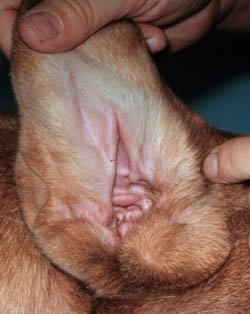
Picture of Healthy Dog Ear
Fungus and bacteria on other hand are considered secondary problems to parasites, i.e. parasites cause the dog ear itch, dog ear lesions and bruises, while bacteria and fungus grow due to a secondary infections (caused by another problem) in worsened conditions. This phenomenon of dog ear problems is correlated with a dog having a depressed immune system and problematic environment in the ear.
Allergens and foreign objects are other causes of dog ear itch. All these causative factors lead to excessive discharges from the ear, thus a dog feels uncomfortable and itchy in the outer as well as the inner parts of the ear.
Symptoms:
A canine ear itch is considered the initial stage for any dog ear problem. It starts with a depressed immune response. As a result, populations of parasites, bacteria or fungus grows in the ear.
Dog Ear wax mixed with the excrement of causative organisms and dead tissues appear as ear discharge, which flows in excess.
Flea bites, parasitic activity, fungal and bacterial multiplication causes itchiness in the ear over any lesions and bumps or lumps. A dog thus scratches its ears more frequently.
Along with itching and scratching, restlessness, pain, inflammatory signs and generalized illness are some other symptoms related to the dog ear itch. In other words, an ear itch can be termed as a base for symptoms related to the dog ear problem.
Diagnosing:
Some dogs may scratch their ears habitually; such habits are more common in long haired dogs. Most researchers believe that dogs who scratch their ear more then 5 – 8 times in an hour or so, may be experiencing itchiness in their ears.
Along with scratching, other signs include excessive ear discharge, redness around and within the ear canal, alopecia around ear flaps (dog ear hair loss), lesions and restlessness may help in diagnosing the canine ear itch.
Diagnosis:
The cause of ear itch can be diagnosed by examining the ear discharge under a microscope; different stages of parasite development can be isolated using this method. Similarly, culturing can help to identify the species of bacteria and fungus possibly causing problem.
Treatment:
Though symptoms of ear itch in dogs can be treated symptomatically, a specific treatment of any underlying cause is mandatory to completely eradicate this symptom and eliminate any possible cause.
Specifically, different preparations such as miticides, anti flea preparations, antibiotics and anti fungal drugs have been used to eliminate possible causes of ear itch. Different approaches to such treatments such as topical application, rinsing, dips and oral administration can be done, which should be described and administered by veterinarian only, since a dog's ear is complex and sensitive.
In support, to reduce the symptoms of ear itch in dogs, symptomatic treatment can be done by using different steroidal drugs, natural preparations and by keeping the ears clean. Natural solutions include products such as Ear Dr. for general ear cleanliness and care, and Mange Mites Spray to repel and keep mites away from the ears, and FleaDerm, if fleas are the dog ear problem. and by keeping the ears clean.
To prevent ear itch in dogs and other dog ear problems, owners must regularly clean a dog’s ear at least once in a week with available dog ear cleaners. This type of cleaning is limited to the outer/visible parts of the ear. More detailed cleaning of the ear should only be done by a professional groomer or veterinarian. This more complete type of inner ear cleaning, must be done at least once in 6 months. This will surely keep the population of microbes in control, preventing the chances of a itchy ear problem forming.
|
|
