Viruses: Parvo Remedies
Virus Quicklinks
Fluid Therapy Remedy for Parvo:
The initial and most important requirement of treating parvovirus is to control vomiting, diarrhea and dehydration. In this context, it is highly recommended that the affected dog should not be given any thing orally. This is usually termed “No per Oral” NpO approach. This will not only help in inhibiting vomiting, but also will restore the condition of in the gastrointestinal tract.
Dogs must be kept on a fast for at least 24–36 hours, and should only be administered fluids through intravenous (IV) or subcutaneous (SC) routes. Ringer’s lactate containing 5% lactose and additional potassium components should be administered; nutrients, such as calories, proteins, minerals, vitamins etc and these should be administered intravenously.
Once the dog is re hydrated and becomes able to tolerate food, it should be given a prescription diet. Different remedies and preparations of any kind, home, homeopathic (natural approach to health care) or allopathic (conventional medications that address symptoms), should only be administered in dogs in which vomiting has ceased and that can tolerate oral intakes.
Prescription Diet; Remedy for Parvo:
Prescription diets must be considered the most effective remedy for Parvo dogs. Prescription diets; should be in a liquid form, preferably and the remedy must contain not more than 5–10% dry matter. It should be a balanced diet, with low fat content (5–10%) and should contain moderate fiber and high-energy contents. Liquid prescription diets are available, commercially and should be given in small volumes, 1–3ml, 6–12 times a day. The diet should be continued; until the dog can tolerate solid foods and is able to have meals and other remedies.
One commercial diet that meets most requirements for dogs that are able to eat solid foods is Royal Canine Veterinary Diet - Low Fat. This product is low in fat, has adequate protein, fiber, vitamins and minerals. It contains 78% water which can be further diluted to emulate a more liquid diet.
Home Remedy for Parvo:
Home remedies are economical, but are not balanced. Home remedies can be made of fresh and quality components, but are not ensured to be properly balanced. At home, monitoring of the dogs improvement cannot be precisely calculated.
That said, Home remedies and foods are highly recommended in dogs which are re hydrated and vomiting has been controlled. Though commercial foods are available, a home-prepared food remedy for parvo is an effective option for long-term management as long as the diet is created in consultation with a veterinarian or veterinary nutritionist.
Home-prepared foods may contain rice as a major component, combined with egg whites, low fat beef, or boiled chicken etc. In the initial stages of treatment, this remedy of rice, egg white and boiled chicken, can be combined with pedialite or Gatorade and administered with the help of a dropper or feeder.
Dogs, which show some resistance to home remedies, can have honey on their gums, for energy and tolerance buildup.
Homeopathic remedy for Parvo:
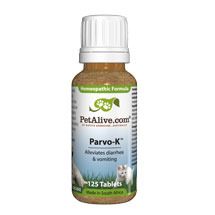
Remedy for Parvo
Homeopathic remedies like Parvo-K are formulated with ingredients selected to protect against symptoms like vomiting, diarrhea, and fever
Source: Pet Alive
The major concern in parvo virus infection is that of vomiting and dehydration, and affected dogs are highly intolerable to any component delivered orally. Available Herbal and/or Homeopathic preparations can only be delivered orally, which is not recommended until vomiting subsides or patient is rehydrated. Thus, in critical stage, herbal preparations are of no use.
Once a dog is rehydrated and the vomiting has stopped, homeopathic remedies containing, Arsen, Verat, Belladona, and ginger, can effectively help to heal or reduce the chance of major symptoms, such as diarrhea, vomiting, inflammation, fever and pain. One product to consider that is made for this purpose is Parvo-K
|
|
