General Care: Senior Dog Care
Dog General Care QuickLinks
Older Dog Health Problems Guide:
The most common senior dog health problems are outlined below. Be sure to follow any advice provided under the care of a veterinarian who can best advise you how to maintain the best quality of life for your dog.
There are several symptoms that can indicate a more severe health problem. These include:
- Diarrhea (that lasts more than 2 - 3 days)
- Vomiting
- Change In Eye Discharge
- Bloody discharge
- Urinary Accidents
- Unexplained Changes in Behavior Such as Acting More Aggressive, less active, not as playful, inability to remember
- Changes or Trouble or Labored Breathing, Cough
- Reluctance to Exercise, Lethargy
- Signs of Muscle or Joint Pain, Changes in Gait or Walk
- New growths or lumps, or that change in the way they look
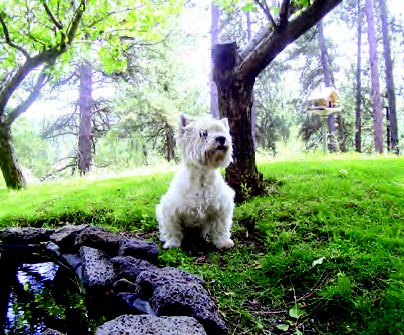
Older Dog Health Problems in dogs that appear healthy often have some level of arthritis which causes a dog to slow down or show stiffness.
14 Year Old West Highland White Terrier
Arthritis in Older Dogs (Musculoskeletal Problems)
If you notice dog arthritis symptoms such as changes in the way your dog walks or gait, signs of pain, a reduced level of activity, lethargy or tired behavior, and difficulty getting up, then your dog may be suffering from arthritis.
All of these signs point to arthritis as the older dog health problem. Even a dog with arthritis needs exercise, but it should be moderated under your supervision. Take your dog for shorter walks. Consider adding a supplement that contains glucosamine such as Muscle & Joint Support Formula. Ask your veterinarian if your dog would benefit from specific treatment approaches such as an anti inflammatory medication such as a NSAID. Arthritis can't be prevented, with treatment focused on symptoms in order to make the dog more comfortable.
Eye and Ear Older Dog Health Problems
Dog eyesight can change with age. Note if you see any change in the appearance of the eye. Typical symptoms include cloudiness. Observe your dog's behavior and see if the dog has trouble navigating unfamiliar areas such as bumping into furniture or walls. Note if your dog no longer comes running when you hold up a toy at a distance.
To help, keep your dog's environment as familiar as possible. Don't change objects your dog relies on such as the food and water bowl. Change may be gradual so be sure to mention even subtle changes in dog eyesight to your veterinarian.
Hearing is another one of the older dog health problems, which is often due to wax buildup, something that can be easily checked by your veterinarian or groomer. A dogs inner ear is very delicate, for an examination and cleaning is best left to a professional.
Thyroid Problems
The thyroid controls many bodily functions. Signs of a thyroid problem such as hyperthyroidism includes reluctance to eat, loss of weight, low energy, and a reluctance to exercise.
Other thyroid related problems include Cushing's disease where a symptom may be changes in a dog's coat.
It is essential that your dog receives all the required nutrients. At minimum make sure your dog has a meal 2x per day. Be sure to take your dog to the veterinarian for a clinical exam and to check organ function. If weight gain is an issue, supplements such as PetAg DogSure Meal Replacement Food Supplement may help.
Urinary Problems
Urinary problems in dogs include kidney disease, cystitis (stone formation) and bladder stones. Symptoms of this type of disorder include dog blood in urine, and difficulty with urination such as straining or pain while urinating. Also changes in urinary habits could be a sign. A lack of urination, changes in frequency or a weak urine stream could be signs of an obstruction that should be taken care of immediately by your veterinarian.
Urine is natures way of keeping the urinary tract clear of infection. Help starts with increased water intake. This combined with walks out of doors, even adding 1 additional walk, will encourage urination. The other way to help is to improve the PH of the urine itself. This can be accomplished with a urinary supplement such as UTI-Free Formula.
If dog bladder stones or kidney stones are the problem, your veterinarian may recommend a prescription diet formulated to either dissolve the stones (if a struvite stone), or to prevent future stone formation. The more common oxalate stones either need to be flushed from the body or removed via a surgical procedure.
If constipation is an issue, then a senior dog food may be of help since these are formulated with a higher concentration of fiber.
Older Dog Health Problems: Teeth and Gums
The mouth is an environment that without daily brushing, can lead to the buildup of bacteria which can not only erode the teeth, but enter the body as well. Symptoms associated with canine dental disease includes teeth that fall out and bloody gums.
To maintain good dental health be sure to brush your dog's teeth everyday. Get a professional cleaning at least 2x per year. Dry foods made to improve dental health could help reduce plaque buildup.
If your dog can no longer handle dry food, switch to a dog food that is canned or consider gradually switching to a homemade food that is formulated by a veterinary nutritionist for your dog's specific condition.
|
|
