General Diseases: Lyme Disease Symptoms
Dog General Diseases and Symptoms QuickLinks
Lyme disease is a term that applies to several
different types of bacteria transmitted by ticks. Symptoms of canine
lyme disease are dependent on the type of bacteria that has been
transferred by a deer tick to your dog (it is also possible to get lyme
disease from a blood transfusion if the donor was infected). Humans
cannot be infected by a dog or a cat.
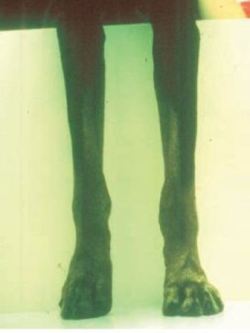
Symptoms of Lyme
Swollen Dog Limb due to Lyme Disease
Source: CDC
The group of bacteria that causes infection is called Ehrlchiosis. Each form of ehrlchiosis bacteria tends to infect a specific type of white blood cell or the platelets.
- White Blood Cells: (granulocytes, monocytes, lymphocytes) which are the way they body fights infection.
- Red Blood Cells: transport oxygen (not infected by lyme)
- Platelets: help
the blood to clot
Monocytic Ehrlichiosis Bacterial Infection
(Most Common Form of Lyme Disease in Dogs)
In this form of canine lyme disease, the bacteria enters the white blood cells. Bacteria enters white blood cells in the kidneys, lungs, lymph nodes, bone marrow, blood, liver, nervous system and spleen.
Lyme disease dog symptoms due to Ehrlichiosis Bacteria appear in 1 to 3 weeks. Symptoms can be barely noticeable for more pronounced and include:
- Fever
- Depression
- Appetite Loss (Anorexia)
- Weight Loss
- Weakness
- Bleeding disorders
Less common lyme disease dog symptoms include:
- Discharge from the eyes
- Discharge from the nose
- Enlarged lymph nodes (lymphadenopathy)
- Swelling in One or More parts of the body (edema)
- Lesions on the eyes
- Lack of muscle coordination (ataxia)
- Enlarged Liver (hepatomegaly)
- Enlarged Spleen (splenomegaly)
- Death
Medical tests often show a low platelet, red blood
cell (anemia) and white blood cell count, a high protein count in the
blood (globulin), and higher than normal liver enzymes.
Lyme disease dog symptoms are often more severe in puppies.
Diagnosis of Monocytic Ehrlichiosis Bacterial
Infection
Lab tests ( indirect fluorescent antibody test:IFA, SNAP7 3DX) are used to diagnose this type of lyme disease. Testing often shows a decrease in your dog's platelet count, the blood cells that cause clotting (thrombocytopenia), low red blood cell counts (anemia) and lower white blood cell count (leukopenia). Your veterinarian may also find enlarged lymph nodes and higher than normal liver enzyme counts.
Treatment of Ehrlichiosis Bacterial Infection
Antibiotics are used to treat this type of lyme disease (Tetracycline, Doxycycline) for 3 weeks. If your dog has a severe case then treatment can last 1 year. If your dog has a severe case then your veterinarian may recommend a blood transfusion. Dogs with this problem are expected to make a full recovery. In some cases the prognosis is not as good if all parts of the blood are affected (low white, red and platelet counts, a condition called pancytopenia). Similar concerns exist if your dog has a heart deformity (hypoplastic) or bone marrow disease (aplastic bone marrow).
Canine Lyme Borreliosis (common)
This type of lyme disease is caused by bacteria that is transmitted by ticks and is also commonly seen in both people and dogs. It is believed that for the disease to take hold, the tick would have to be feeding on your dog for 24 to 48 hours.
This type of lyme disease in dogs usually infects the areas closest to the tick bite.
Lyme Disease Dog Symptoms due to Canine Lyme Borreliosis
- Lameness
- Fever
- Enlarged Lymph nodes near the bite site
- Low red blood cell count (anorexia)
Treatment of Canine Lyme Borreliosis
Antibiotics (doxycycline) are used to successfully treat this form of the lyme disease over a 1 month period. You should see your dog start to feel better 1 day after treatment begins. It is possible for a relapse after treatment.
Severe cases are more difficult to treat.
Granulocytic Ehrlichiosis
This type of lyme disease in dogs is caused by bacteria which infects a type of white blood cell. There are two prevalent symptom groups for this type of bacteria.
The first group of lyme disease dog symptoms associated with this type of lyme disease will make it look like your dog has arthritis.
- Fever
- Tiredness
- Lameness
- Joint Inflammation (polyarthritis)
The other type of granulocytic ehrlichiosis has similar symptoms to the monocytic form of the infection described above. These canine lyme disease symptoms include:
- Low red blood cell counts (anemia)
- Enlarged lymph nodes
- Low platelet counts
Note that tests used to detect other forms of lyme disease may not work to detect this form.
Treatment is with antibiotics as mentioned above.
Infectious Cyclic Thrombocytopenia
This form of lyme disease in dogs only enters into
the platelets. Lyme disease dog symptoms is usually a mild fever.
Babeiosis Lyme Disease in Dogs
This isn't a form of bacteria, but caused by an organism called a protozoa or parasite. This parasite causes puppies to get very sick, and only causes mild symptoms in adult dogs (in South Africa, varieties of Babeiosis can kill adult dogs).
Lyme Disease Dog Symptoms of Babeiosis parasites:
- Urine that is brown
- Weight Loss
- Fast Breathing
- Rapid Heart Beat
- Weakness/lethargy
- Avoidance of Food (anorexia)
- Fever
- Vomiting
- Enlarged Spleen
- Jaundice (discolored, yellow eyes, skin)
Diagnosis of Babeiosis Canine Lime Disease
This type of lyme disease in dogs can be diagnosed with a blood test (IFA). Your veterinarian will be able to see the parasites which infected your dog.
Treatment of Babeiosis
Dogs are usually not treated for this condition if symptoms are mild. If treatment is required, then the drug Imizol, Azithromycin or a type of steroid is used depending on the type of parasite your dog is suffering from. Note that these drugs like Imizol have potential side effects that could negatively impact the kidneys or liver.
Homeopathic Remedy for
Lyme Disease Dog Symptoms
Homeopathic remedies have a long history of
providing the body with extra support. A product called PetAlive
TF-Defense Formula is specifically made to help with the
natural treatment of acute Lyme Disease or other tick borne diseases in
pets. It might be worth mentioning to your veterinarian as part of the
treatment process. Ingredients such as Milk Thistle, Cortalus hor and
others have a long history of supporting the liver and blood cells. The
company also has additional information on lyme disease in dogs that
might be of help.
|
|
