Giardia: Overview
Giardia Quicklinks
Life Cycle:
Giardia is a parasite; a protozoa which is found as a “cyst” in the environment, excreted by an infected dog. Once the cyst is ingested, an active form of parasite called “trophozoite” is released in the small intestine. Trophozoites are flagellated and can move around freely. These trophozoites attach themselves to the walls of the intestine and not only absorbs nutrients but also forms a layer over the intestinal lining, thus disturbing the phenomenon of nutrient absorption. These trophozoites, when they get enough nutrients, multiplies by binary fission (non reproductive mitotic division).
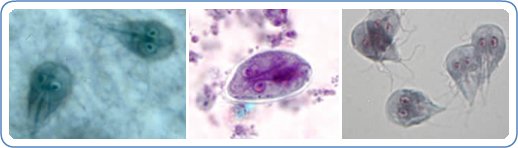
Giardia in Dogs is caused by a parasite that draws nutrients from the dogs intestine. When they grow large in number, clinical Giardia symptoms such as canine diarrhea occurs.
Source: testinalis trophozoites in Kohn stain. Center: G. intestinalis cyst stained with trichrome. Right: G. intestinalis in in vitro culture, from a quality control slide. Credit: DPDx
Signs and Symptoms:
During the infective stage, i.e. release of trophozoites and their multiplication is usually not termed true “Giardiasis”, and clinically, this stage is asymptomatic. Once the maximum number of cysts is produced in the intestine and a large portion of the intestine is covered along with disturbed nutrient absorption, giardiasis has occurred with the appearance of prominent clinical dog giardia symptoms.
Intermittent, acute (sudden) or chronic diarrhea is noted, which has a bad odor and is greasy. The dog diarrhea contains mucous and fats, and the patient shows low or no signs of loss of appetite, but weight is lost progressively along with distinguishable weakness due to diarrhea and lowered nutrient absorption.
Watery diarrhea is uncommon and rare cases of giardia in dogs have been reported with dog blood in feces. In the infective stage or when there is a less severe infection, feces are pale and soft with a bad smell. Dog vomiting may be noticed occasionally. Transmission of the Giardia canis species to humans is controversial amongst researchers and veterinarians. Research and further studies are needed in this context, but almost all researchers believe that Giardia should be considered capable of causing infection in humans, even though it is unknown.
Diagnosis:
Clinical signs, history and ordinary tests cannot confirm Giardia in dogs. Cysts of Giardia are usually not released with every excretion; therefore three samples a day for at least 3 – 5 days are required to be examined through the flotation technique, followed by saline smear examination under a microscope. Oval cysts are best identified if smear is concentrated in zinc sulfate.
It is noted that flotation and concentration techniques may fail due to a lower infective level, therefore advanced techniques like ELISA can be used to detect the specific giardial antigen in the feces, but the specificity and severity of the infection cannot be detected with this technique.
Giardia in dogs should be differentiated from other similar conditions, like nutrient mal-absorption, pancreatic insufficiency etc.
Treatment:
There is no approved treatment for giardia in animals. Different anti-parasitic drugs, like Fenbendazole and Metronidazole are very effective in controlling cysts in feces and no side effects have been reported. Also, Fenbendazole is safe for lactating and pregnant animals. Fenbendazole is not an approved drug, but it is commonly used for controlling giardia in different countries. Another combination, containing praziquantel, pyrantel pamoate, and febantel can significantly control cysts in feces.
In either way, controlling excretion of cysts in feces cannot be termed as treatment, but controlling of the lifecycle of the parasite.
The dog
giardia treatment plan prescribed by a veterinarian is
comprised of
therapeutics, instructions to improve hygienic measures, disinfection
by ammonium compounds and bleach, steam and boiling water. It is
also important to support a dog or puppys immune system with a high
quality nutrition.
Natural remedies can also help in reducing clinical signs and in improving digestive health and firmness of the dog stool. These herbal remedies should be continued even after completion of the specific therapeutic course. Helpful products include Parasite Dr. (promotes blood and immune system health), Natural Moves for Pets (promotes normal bowel function) and Digestive Support (promotes digestive health and nutrient absorption).
Dogs affected by giardia should be observed closely, since cysts may exist in the environment for weeks to months.
|
|
