Hormonal Disorders: Thyroid Disease Causes
Dog Hormonal Disorders Quicklinks
Causes of Canine Thyroid Disease:
They thyroid is a gland that consist of two lobes,or divisions with a single stalk. It's location is adjacent to the apex of the trachea (wind pipe) and vertically parallel to the larynx.
Canine thyroid disease is categorized as either primary hypothyroidism (the disease started in the thyroid gland) or secondary hypothyroidism (when another problem in the body triggers a thyroid problem).
Primary hypothyroidism refers to the destruction of the thyroid gland itself. Thyroiditis (Inflammation of thyroid gland) & idiopathic atrophy (no growth in gland due to a pathogen of the thyroid gland are two main reasons for impairment in the thyroid gland function or secretions.
In the case of idiopathic atrophy, when the body is fighting a toxin, foreign body, virus or bacteria, the body's response (called a cell medicated immunity or lymphatic response) also reduces the the activity of growth hormones such as those released by the thyroid. Examples of bacteria that can trigger this kind of response includes Coccidia, Histoplasma and mycobacterium. Retro Viruses and Canine Distemper viruses are some examples of viruses that can cause a problem with canine thyroid growth hormone.
The secondary cause of canine hypothyroidism is destruction of the primary cells of the pituitary gland associated with the control of thyroid gland function. Simply, it refers to some tumors of endocrine system of dogs.
Thyroid problems in dogs may be congenital (inherited), e.g. in German Shepherds, dwarfism is usually associated with hypothyroidism.
The causes of canine thyroid disease are varied, e.g. destruction of the glands producing growth hormones in dogs, which may be due to severe inflammation and a diseased condition of the thyroid glands.
The Pituitary gland is called a “Master Gland”. If the destruction of pituitary cells occurs, as a master gland it negatively impacts other glands in the body. The Pituitary Gland controls the hormonal activity of the thyroid glands (growth hormones), which in turn may lead to canine thyroid disease.
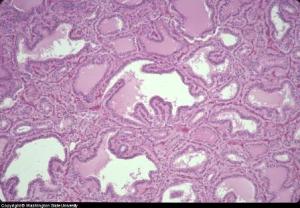
Canine Thyroid Disease
Example of Hyperplastic thyroid (abnormal increase in the number of
normal cells) from an iodine-deficient dog
Source: Washington State University
Clinical Signs & Symptoms:
Canine thyroid disease is more common in dogs age 4 – 10 years. Mid & large sized breeds of dogs are more susceptible to this disease.
Thyroid hormone, if it is deficient, effects almost all organs of body. The signs therefore may appear as variable & non specific.
Common signs include lethargy, mental dullness and weight gain without any equivalent increase in appetite. Some dogs may appear flabby in appearance. Diseased dogs get fever more frequently and are more sensitive to cold; it is said that such dogs are heat-seekers.
Dermal (skin) signs are more common in hypothyroid dogs. Dryness, shedding & then delayed re growth of hair is seen. Hair loss occurs, but the affected dog never feels itchy or irritated.
Skin folds are observable & muscles usually appear flabby. Obesity is common in muscular tissues.
Various reproductive disturbances are also associated with this disease. In females, an estrus (Failure to cycle), infertility, abortion & lowered rate of young one’s survival is common, while in males lack of libido, the stopping of testicle growth, infertility & lowered sperm production is noted.
Severe thyroid disease may lead to coma in dogs, and it may lead to the permanent impairment of organs.
Diagnosis:
Diagnosing thyroid disease in dogs is difficult, as it is associated with almost all organs. Clinical signs vary & are non specific to canine thyroid disease. The clinical signs & history should be observed with extreme care. Routine laboratory testing should be consulted for any recent existing problem.
Laboratory tests will examine the level of different hormones and biochemical examination. Both are helpful in forming a definitive diagnosis of canine thyroid disease.
Treatment:
Replacement therapy or simply replacement of a deficient compound is the only option to treat canine thyroid disease. Thyroxine (T4) is a thyroid hormone replacement choice in dogs. This compound is used in dogs either in a single dose or in parts, as prescribed by a veterinarian, according to laboratory results and observations.
Clinical improvement is the only sign that therapy is working. Changes in skin & weight can only be examined in a period 1 – 2 months after therapy.
Dogs undergoing therapy will need to be observed along with therapy, to ensure that the problem is being resolved and to avoid any complications associated with therapy. These include thyrotoxicosis (Toxic effect of thyroxin through blood). Monitoring will include the measurement of serum or blood components for thyroid hormone concentration, which is called “Post-Pill-Testing”.
Homeopathic Support for Thyroid Problems in Dogs
There is a homeopathic product made to provide an extra level of support for dogs that suffer from thyroid problems. Ingredients such as Fucus vesiculosisis (kelp) and others can help to maintain health thyroid function and support the production of TSH, T3 and T4 hormone. The product is called Thyro-Pet. The manufacturer is a good source of additional information on natural treatment approaches for thyroid in dogs.
Causes of Treatment Failure:
In many cases the clinical signs of thyroid disease may persist despite use of thyroid hormone. It may be due to the incorrect administration or dose frequency of thyroxin. Some dogs may be unable to absorb the dose completely or if they excrete the dose rapidly. Other reasons may be that the owner may not be complying with instructions, the product used may be expired or even the diagnosis for the condition is incorrect or not exact.
|
|
