Digestive System: Liver Problems Overview
Different types of Canine Liver Problems:
Dogs may face a number of problems associated with dog liver health. These may be either infectious, non infectious may affect liver directly or may be due to other organs that are related to liver function.
-
Canine Chronic Hepatitis; Dog hepatits
is the most common canine liver problem. It
may have a number of causes. Viral infections, pathologies of
liver components and contaminated food, water and environment are
some most common causes. Some cases of canine chronic hepatitis
are idiopathic in nature, meaning that the cause is unknown. Some
breeds as Terriers, Spaniels and
Pinschers may be predisposed to it genetically.
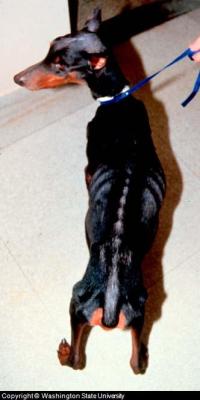
Picture of Dog Liver Disease in Emaciated Doberman
-
Vascular Problems; A dog's liver may develop a severe problem in cases where an abnormality arises in the vascular supply (blood supply). These vascular problems are commonly termed as “proto-systemic shunts” or a canine liver shunt. Some toxins may reach into the liver from the blood supply and cause a severe pathological condition such as liver inflammation, fibrosis (hard fiber strands which causes vascular constriction) or permanent damage to cells.
-
Infections; different viruses, bacteria, fungus and
parasites introduce toxins that may lead to secondary infections in the
liver. These
are commonly different then symptoms noticed in chronic hepatitis.
These
infections can cause hepatitis, but usually of an acute or sudden form.
Viruses may
cause infectious canine hepatitis and canine herpes-virus disease.
Similarly bacteria either damages hepatic cells directly or leaves
toxins outside hepatic cells, leading to an idiopathic form of liver
problem (idiopathic means of unknown cause).
Histoplasmosis and coccidiomycosis are two of the most common liver dysfunctions caused by fungus, ascites (accumulation of fluids in the liver) and peritoneum (membrane lining problem) is usually caused by fungal species.
- Cholangitis and Cholangiohepatitis; Inflammation of the bile duct, is less common in dogs, but collective inflammation involving bile duct and hepatic tissues is a frequently observed problem in dogs. Infection may ascend from the biliray tract to the liver or descends from liver. Bacterial species such as salmonella and campylobacter, parasites and surgical complications may be the cause.
- Abnormalities in Associated Organs; Pathological abnormalities in the pancreas, gall bladder, bile duct, tumors and in vascular (blood) distribution to and around the liver may also cause possible dog health liver problems.
- Canine Liver Cancer: Liver
cancer can originate in the liver (primary) or spread from other areas
in the body. Secondary
dog
liver cancer is more common than primary forms of the cancer.
If caught early and it hasn't spread, surgery and chemotherapy can be
used to
treat the disease.
These are often secondary problems such as diabetes, glycogen storage disorders, cancerous metastasis, idiopathic fibrosis and obstructions that are additional examples of such dog liver problems.
Diagnosis of Liver Problems:
Initially a clinical examination and history may help in indicating a dog's liver as the problem. In the laboratory, biochemical profiles, estimation of canine elevated liver enzyme levels and substrates can help in identifying any problem. Some advanced procedures such as biopsy, cancerous estimation and radiography may confirm different conditions as indicated by cellular changes, hepatic (liver) anatomical disturbances etc.
Treatment Options:
Canine liver problems can never be treated without confirmation. Unlike other organ abnormalities, the liver can never be restricted in function since a number of vital functions are dependent upon it.
Specific canine liver disease treatment is always recommended as per the diagnostic results. Treatment should be continued as per the direction of a veterinarian, as in many cases complications arise when owners do not follow directions provided.
Symptomatic treatment is usually helpful, but is never an alternative to specific treatment for the condition itself. Different drugs for treating symptoms, if used for a longer period of time than recommended, can cause irrecoverable damage to the liver, leaving a dog in shock (when organs in body don't receive an adequate flow of blood) or would be the cause of death. Even incurable canine liver problems cannot be purely treated symptomatically, which would normally be done to improve a dog's life quality or for added support.
Canine liver disease Dietary management is a must when treating canine liver problems; diets that contain abundant levels of vitamins, minerals and milk proteins are during recovery.
Support with vitamins, minerals and some herbal preparations can improve the physiology of partially damaged liver tissues. The liver has the capacity to regenerate itself, meaning that damaged hepatic tissues can repair themselves. They regenerate from stem cells called ovalocytes, which develops into hepatocytes or cholangiocytes, the cells which form the liver.
Regeneration is purely based upon the degree of damage. If a hepatocyte has been damaged up to 25%, the liver can regenerate the damaged part ont its own, but additional support and supplementation is usually required to repair damage that is greater than 25%. Also, if damaged tissues remain untreated or not treated in a timely manner, permanent damage is possible. If left too long, such tissues do not regenerate or repair themselves.
Choices of herbal preparations or supplements include Immunity & Liver Support Formula if the problem is due to an infectious disease, or Liver-Aid Formula for general support, such as when dog liver enzyme levels are elevated. Check with your veterinarian.
|
|
