Causes and Treatment of Dog Skin Pimples
"Dog skin pimples are actually a blockage of the skin's sebaceous and sweat pores. These pores are responsible for the release of sebum – oily secretions, which keeps the skin surface free of dandruff. Dandruff or drying skin can lead to the death of epithelial dermal tissues (outer layer of the skin), scaling and hardening of the skin. This is also known as the thermoregulatory activity of skin, with help of the sweat glands. These pores once blocked due to any reason e.g. allergy, parasitic infestation, fungal or bacterial infection can cause the accumulation of dead tissues, sebum and sweat under the skin pores, particularly at the base of hair follicle. This accumulation appears as a pimple on a dog’s skin. These dog skin pimples can appear anywhere on the skin and may be itchy, painful, and appear as pustules. Diagnosis is only possible once these pimples mature and appears on the skin surface. Treatment involves the use of different anti–allergy drugs combined with antibiotics and NSAIDS."
Causes of Dog Skin Pimples
Canine skin pimples are a blockage of skin pores. These pores are responsible for secreting not only the required amount of oils to prevent scaling and drying of skin, but also they help in excreting excessive water, thermoregulation and for maintaining skin dampness. Factors which can block skin pores result in the accumulation of all of the secretions and excretions under the skin surface, which on maturity appear as a dog skin pimple.
- Allergies:
Allergy is most common reason for skin pimples in dogs. Flea–bite allergy
is one example. Oral fluids of the flea’s mouth contain compounds which
are histamine in nature and which cause severe inflammation on the skin
surface such as when a flea bites. Inflammation results in the swelling
of skin tissues, thus reducing the space for secretions and excretions
to flow from the skin spores. This blockage results in a dog skin
pimple.
The contents of allergic pimples contain dead tissues, inflammatory and lymphatic cells, dead antigens and haptens, along with oily secretions and fluids like water and proteins. Other allergies like atopy can cause a hardening of the skin, and scales on skin surface which block the opening of the skin pores, thus resulting in dog skin pimples.
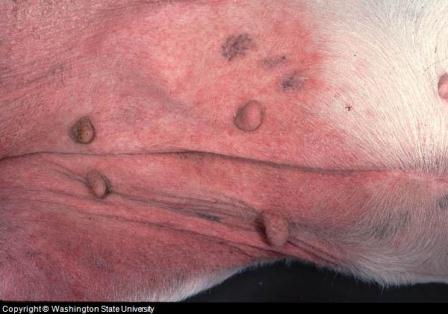
Dog Skin Pimples on Stomach of Bull Terrier Caused by Atopic Dermatitis
Source: Washington State University
- Parasites: Some species of mites can cause an infestation that results in a blockage of the skin pores. Mite infestation causes itching and irritation to the skin tissues and with self injury, such as scratching, these tissues can get inflamed. Another phenomenon is that of a crust and lesion pathology. Parasitic infestation may cause crusts, papules and lesions on the skin. These lesions and crusts can block the skin pores resulting in an accumulation of sebum, sweat and dead tissues, which latter on appear as exudates (secretions) from these lesions. The pimples in such cases are usually not separable from the lesions and crusts, but pathogenesis favors their existence.
- Fungus: A group of fungal conditions, collectively called dermatophytosis is one example of a cause of fungal pimples on dog skin. Species of Microsporum and thyrophytons cause dermatophytosis, which result in small granulomatous pimples on the skin, which gets hardened in chronic cases. These cause itching and irritation due to a high degree of keratinisation (hardened component of skin).
- Infections: Bacterial infections may cause canine skin pimples. Species of Staphylococcus, mainly S. intermedius & S. aureus cause canine skin infections. These are opportunistic pathogens, which act on a secondary basis when causing pimples. They can cause a blockage of skin pores by producing puss, and pimples may appear as slightly harder crusts, which latter on develops into abscesses. Abscesses are painful and contains puss.
Diagnosis of Dog Skin Pimples:
Canine skin pimples may be diagnosed and differentiated with a physical examination and by taking a history of the condition. Different techniques such as an examination of skin scrapings for parasitic causes, culturing, the isolation of Staphylococcus species for bacterial invasion, and serum & hypersensitivity tests for allergy detection can be helpful. Examination of the contents of the pimples may reveal antibodies for a specific antigenic matter.
Skin pimples on dogs should be differentiated from several other types of skin lesions. The blockage of skin pores usually is found at the base of the hair follicle.
Treatment of Dog Skin Pimples
Treatment should only be initiated once the cause of the canine skin pimples is confirmed. Systemic administration of several drugs can lead to a positive result, only if the localized treatment plans are effective.
Parasitic infestations can be treated by a dip of amitraz or an over the counter lime-sulfur dip such as Naturasil. A mites’ infestation can also be treated with Ivermectin, Selamectin & Melbemycin.
Shampooing is another option. Medicated shampoos containing repellents for mites and fleas are usually effective in treating dog skin pimples.
Bacterial infections can be treated with broad spectrum anti-biotic therapy. Penicillin at a dose of 10000 – 50000 IU/Kg (Intra Muscular IM Injections) and first generation cephalosporin’s like cephalexin at 22 mg/Kg per oral doses are considered to be an effective approach for staphylococcal species that cause skin pimples in dogs.
Have A Question About Dog Skin Pimples For Our Vet or a Helpful Story to Share?
Do you have a question for our Veterinarian or a helpful story about this? Share it!
Please include the age of your dog, breed, the area of the body, your dog's general health and any changes in diet, appetite, behavior, skin and coat. Let us know about any treatment that is currently under way including the names of medications or any other information that could help our editors provide an answer.
If possible, please submit a picture of the canine skin condition below.
We will do our best to get back to you quickly (it depends on how many questions we receive each day). If you do require an immediate response we suggest using this online dog veterinary service that is available now.
Other Reader Dog Skin Questions and Answers from Our Vet
Click below to see contributions from other visitors to this page...
Concerned with Dog Ear Pimple Not rated yet
I have a 2 yr old Puggle that developed a pimple like sore on the outer rim of her ear canal. It's not a hematoma because it popped on its own and only …
Red Bumps on Dog Stomach Not rated yet
Reader Question: Pimples on dog stomach
My dog has developed several red bumps on his groin area (and one on his chest) in the last couple of days. …
|
|
References:
Paterson. Skin Diseases of Dog – Revised Edition (Blackwell Science
Ltd. 2000)


This site accepts advertising and other forms of compensation for products mentioned.
Such compensation does not influence the information or recommendations made.
We always give our honest opinions, findings, beliefs, or experiences.
All rights reserved. © 2018 Dog Health Handbook.